
Powering voice picking for

eoStar
Voice picking for warehouse management

The Numina Group
Voice picking for warehouse management
KeenASR is one layer in a voice picking setup. Here is where it fits, and what stays exactly as it is.
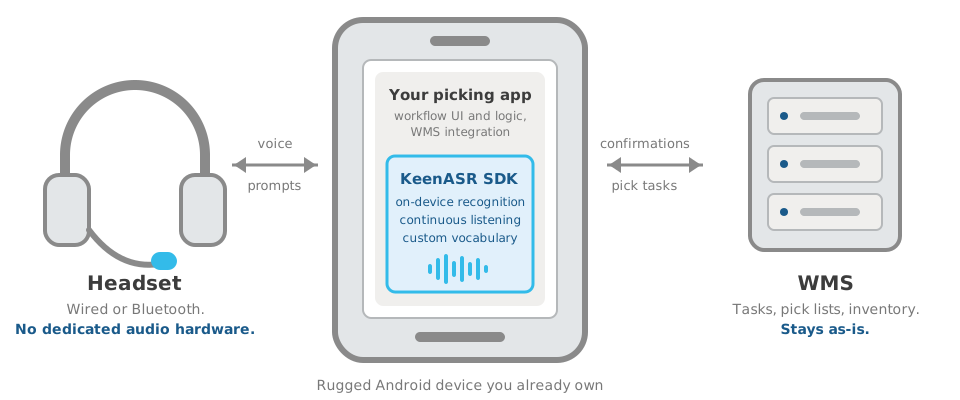
KeenASR is the speech recognition layer, not a WMS and not a picking application. If you already have a picking app, integration is an SDK drop-in. If you don't, we work with your team or partners to get one in place (see paths below).
For developers: your app programmatically defines what the recognizer listens for at each step of the workflow, which is what keeps command-driven flows accurate in a loud warehouse.
Warehouses are loud, fast, and full of words no general-purpose recognizer has heard: "bin C3", SKU codes, "short pick", your own names for zones and carts. KeenASR uses deep neural networks trained for real-world acoustic conditions and listens only for the commands and vocabulary your operation uses, so it stays accurate when the shift gets busy. Recognition runs continuously on the device, with nothing depending on a network round-trip, so workers keep their hands on the product and their eyes on the aisle, with gloves on, in aisles and yards without Wi-Fi.
KeenASR SDK is Zebra Validated: tested and validated by Zebra Technologies to run on Zebra rugged Android devices.
Three common starting points, and what each one involves.
Path A
Your app already does voice picking on-device with another embedded ASR engine, and you're evaluating alternatives on accuracy, licensing, platform support, or roadmap. Migration means swapping the recognition layer inside your app: port vocabulary and grammars, replace SDK calls, and benchmark side by side on your audio.
We invite the comparison: send us recordings from your warehouse, or run our trial SDK against your current engine. Licensing is a flat annual license, with no per-user or per-request fees.
Effort: smallest. You swap one component; the app, devices, and workflow stay.
Download trial SDKPath B
Workers tap and scan today; you want them to use voice and keep their hands free. Integration means adding the SDK to your existing picking app, defining your command vocabulary and grammars with us, and wiring recognition results into the workflow logic you already have.
Effort: moderate. You add a capability to an app you already run; nothing is replaced. This is the "pilot in weeks" case.
Start a pilotPath C
Your voice picking runs on proprietary hardware with vendor-controlled task software, so moving means replacing both. You need a picking mobile app (your WMS vendor's mobile client, a voice-app partner, or built in-house) with KeenASR as the recognition layer.
The payoff: hardware freedom, vocabulary you control, commodity device pricing, and no dependence on a terminal vendor's roadmap. Our professional services cover integration and proof-of-concept development, and a pilot can run in one zone alongside your existing system.
Effort: largest. You replace a system, not a component: terminals, task software, and recognition go together, which is why the pilot runs alongside the existing one.
Talk to our engineersEvaluate it hands-on before anyone books a meeting.
The SDK runs natively on Android, Linux, and ChromeOS, and can be ported to custom hardware. iOS is supported as well, if you run a mix of devices.
A typical pilot runs on a handful of your existing devices in one zone or workflow. We help integrate the SDK with your app, customize vocabulary to your pick commands, and benchmark recognition accuracy in your warehouse with your workers. Most teams have a working proof-of-concept in weeks, not quarters. Professional services are available for integration, model customization, and custom hardware.
If you're comparing recognition engines, the pilot is the benchmark itself: same devices, same workers, same audio. If you're coming from a dedicated voice-terminal system, the pilot runs in one zone alongside it, in parallel rather than rip-and-replace.
KeenASR also powers field operations, healthcare, retail, and custom hardware. See enterprise use cases.